
BUDDHISM AND EMPTINESS
Buddhism is articulated around two complementary elements that differentiate it from other spiritual paths. The first is the notion of emptiness ( anatman or shunyata ) defining Buddhism as a tradition of non-theistic, non-deterministic and non-dogmatic. The second is the meditative process called penetrating vision ( vipashyana ) that allows to reach and integrate the understanding of emptiness in everyday life. The term "emptiness" refers both to the lack of independent identity of the people (in this case as anatman ) and all kinds of phenomena (in this case as shunyata ). The first perspective flourished mainly between schools of Hinayana (Sautrantika and vaibhasika) while the notion of shunyata that in a sense, be regarded as a consequence or a deepening of the first, developed between the schools that make Mahayana (cittamatra and Madhyamaka), all according to the ranking Tibetan Buddhist schools that we can not forget that it has a literal historical correspondence.
To investigate the nature of self and coming to understand what the emptiness of the I must, first, try to perceive, clearly and distinctly, the object under investigation. In this case, the object under investigation is the self. Thus, input not say that I exist or not exist, but only to be investigating how it manifests. First, determine if it can be isolated or be defined as a purely physical or purely mental. Thus, I find that the body is not an element because it can not be associated or located in any particular part of body, heart and even the brain. Nor is it a purely mental element because it can not be identified with a state of mind, a certain feeling or thought. Similarly, one can not say that I is independent of body or mind because I always refer all our experiences in this course I am. So when we are cold, for example, say 'I have a cold "and not" my body is cold. " Or when we feel sad we say "I'm sad? and no, "my mind is sad." On the other hand, this self is not something independent of the psychophysical complex, because to refer to it whenever we have to regard to certain physical or mental. I can imagine that "my" hand, "my" head, "my" pain or "my" depression belong to me, but I can not imagine a self without a body, no feelings, no thoughts and, ultimately, without a support psychophysical with which to identify. Consequently, we build all our experiences around me, but if we stop to look for, locate or define it can not find it. Dogen, one of the most important teachers of Japanese Zen Buddhist summarizing the position regarding the "I" as follows: "To study Buddhism is to study the self. To study the self is to lose the self. "
On the other hand, the inability to locate the self, when we analytically, must not lead to the hasty conclusion that the assertion of the doctrine of anatman is that I does not exist in any way. From the above can be clearly inferred that Buddhism does not propose the simple annihilation of self, but only the right experience and in that sense all I said is that the self is not an independent, a ghost atom or an absolute entity, but a functional category used to describe a set of phenomena, a charge established in dependence on a series of psychophysical events. The outright denial of self reduce the prospect of anatman to position nihilism, one of the two extreme philosophical Buddhism has always tried to avoid. Anatman not useful, of course, I say a supposed transcendental, immutable and eternal separated from an empirical self, transitory and earthly, which would lead to the extreme philosophy contrary, the eternal.
Therefore, the sense of self, although present in each of our experiences, is beyond all determination, fixing or sclerotization. When we catch it, define it and turn it into a fortress in a final or absolute point reference becomes a source of problems, but living the right way is the very road to enlightenment. Buddhism, in short, states only that the ego is a filter, a state of consciousness, an interpretation of reality acquired through both education and to over millions of years of biological evolution. In the latter sense, from the Buddhist point of view, one could say that all the developmental stages, from the amoeba to the human being have the ego-consciousness thread that more or less sophisticated, tries to perpetuate its separate existence or false independent through what modern psychology would define as a large range of repressions and projections.

On the other hand, the Mahayana schools they are extending the principle of indeterminacy of the self in all phenomena and internal and external categories. So while anatman is a critique of the concept of "absolute subject" shunyata , delving into such criticism, brackets the idea of \u200b\u200b'object absolute. " Shunyata include a review of monolithic or static nature of the concept of substance. Our reality seems solid, substantial proof and is, at best, pure movement. Appear and disappear simultaneously. Therefore, given the instantaneous or momentary all elements of existence is impossible to apply any more definitive.
We are committed to the pursuit of wisdom, but "for the wise everything is pain." Wisdom is disappointment in the real sense of the term Unveiled contemplation of reality. So to be able to withstand the harsh vision of impermanence, suffering and lack of inherent existence of our own selves, we need to have a well trained staff who have completed all previous evolutionary stages. For example, when the Buddha renounced the world had something to give. He was a king who had enjoyed all the wealth and splendor of life. This is what in Buddhism is called "precious human life," which, of course, can not be truly beautiful until you complete their possibilities spiritual or transcendental, but to be able to develop such opportunities need to maximize their possibilities of purely human experience. To receive the most unsatisfactory aspects of existence must have a strong psychological ego. But a strong ego does not mean a selfish ego, wild and undeveloped, but a rich ego capable of assimilating all kinds of experiences, educated in the real sense of the word education does not depend on books that are read or the particular social background. To become a beggar, you must first be a king.
Also, in regard to any concept of emptiness of reasoning might be similar. Nagarjuna would appear that we are advising us to discard any kind of effort into learning and give up any intellectual activity. However, the historical fact is that both Nagarjuna and many other Buddhist teachers held a wealth of literature and philosophy which is rather paradoxical teaching that apparently escapes all conceptualization. The bracketing of the notion of substance does not imply the nihilistic denial of reality but only the complete identification between being and becoming, with the subsequent and surprising discovery that each individual existence is a synchronous event that is supported by so to speak, on the whole. Every existence concrete has as its foundation the rest of the universe and is a reflection of an infinite series of relations, constituting, in turn, both the target as the starting point of the simultaneous cooperation of all elements of reality.
is easy to understand the non-theistic Buddhism if we extend the principle of emptiness, both the self and phenomena, on a cosmic scale. A divine ego independent of the universe seems as unlikely as an independent ego at the human level. It should be noted, incidentally, that emptiness is not, by itself, a creative principle. As regards a possible explanation for the origin of the world, in any case, adopting in Eastern philosophies as a creation ex nihilo , Buddhism has always been pluralistic, that is, has tried to explain the emergence of phenomena by postulating that come from a collection of concurrent and interrelated causes. Because one does not derive any effect because the latter is the result of overlapping causes. The notion of emptiness, therefore, is also a critique of the linear theory of cause and effect. This is important when considering what can be, from the Buddhist point of view, the exact criteria of the law of karma, for example, that, like so many ideas of Buddhism, is often interpreted in a standardized way.
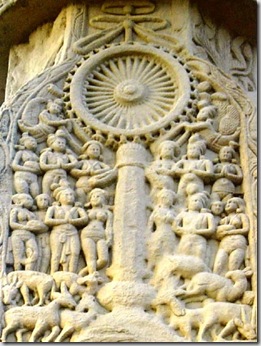
Regarding his anti-dogmatism, from the initial statement of the Buddha Shakyamuni where advised not to rely on the high authority of the people, salvation promised by the revealed messages or the prestige of immemorial traditions, Buddhism has always been accessible to both critical thinking as a direct meditative experience. Following the presentation and reflection on the vision of emptiness is meditation, or by applying experimental finding in the laboratory of awareness of the teachings. In Zen Buddhism is said in this connection: "Listening to the ear, meditate on the heart and practice with the body."
own Buddhist meditation called vipasshyana . According to one of its etymological sense, the vipashyana also involves a contemplation of reality "in reverse" of our habitual way of looking at things. That sense coincide with the famous quote from Lankavatara-sutra that speaks of revulsion in the fundamental consciousness, that is, if you're used to the perspective I try to put us in the not-self if we are accustomed to have, try to conceive the situation from the standpoint of not-having, if we are accustomed to contemplate the flow of existence from an imaginary center, trying to understand how we got to be the center and check if is possible to envisage the existence otherwise. So Buddhism does not propose essentially nothing. All it does is provide elements to dismantle our system of idols philosophical, scientific, religious, personal, existential, etc..
However, we should not conclude from this that Buddhism is comparable to systematic skepticism of the Stoics, which constitutes a closed existentialism in his own anguish or extreme agnosticism. Any comparison between the views of eastern and western philosophy is merely a recall because, in the East, has never developed a philosophy speculative separated from life or understood the theory separated from practice. In any event, the East has philosophized whole being and not to the intellect only.
To help this detachment, this revolution in our outlook on life, we need to implement a sustained research in the beginning, not disdain reasoning. But this research is not an end in itself but a means applies both to check the validity of the teachings and to consolidate and settle any meditative experiences. It is not therefore a mere intellectual inquiry that led to its ultimate consequences, always leads to a dead end. However, it is always preferable that the end to become a blind follower. Research and doubt are the best guarantee of freedom available to the human mind and as such, we hardly give them up. Therefore, we must be wary of those systems that do not allow exploration, questioning or doubt. Conceptual thinking is not bad in itself. Wrong, in any case, it may be the use or our relationship with him.
Doubt, lived from the depths of being, may take the form of an investigation and a thorough search, but non-speculative or intellectual capacity, as evidenced by the famous koan of Zen Buddhism, representing the research instruments most important emptiness. Therefore it is said in Zen the Great Doubt, next to the Great Faith and Great Power, is one of the three pillars of practice. The goal of koan whole being is to merge with the state of doubt that, after all, is the essence of the intelligence budget and the entire learning process. This feeling of doubt is technically called I-ching . But ultimately, all koan and even philosophical issues all boil down to one question: "What-or who-me." And in the end all that matters in this question is not its content, but the question it raises. And not the who or what, but only the existential question empty of all concepts, content and budget. And beyond, there is only the place from which emanates the question. On the other hand, this question not only symbolizes the irreducible mystery of life but, in relation to Buddhist practice, continually encouraged to rediscover and integrate the message of the teachings and not limit ourselves to the ape imitation or repetition of the parrot . Only then can we have direct experience of reality that is truly original.
Theoretically at least, in Buddhism, the practitioner is forced to relativize and always put all their experiences in a broader perspective to try to perceive what their real situation and do not conform to ceded ideas other or a sentimental subterfuge that allows sublimate their personal frustrations and fears. You have to start learning to leave everything behind, to not keep anything down. "If you meet the Buddha, kill him," an ancient proverb zen because, ultimately, Buddhism is a raft that helps us cross the untamed river of illusion, but once you have achieved that goal, we must abandon the raft if not want to see prevented any further development.


